
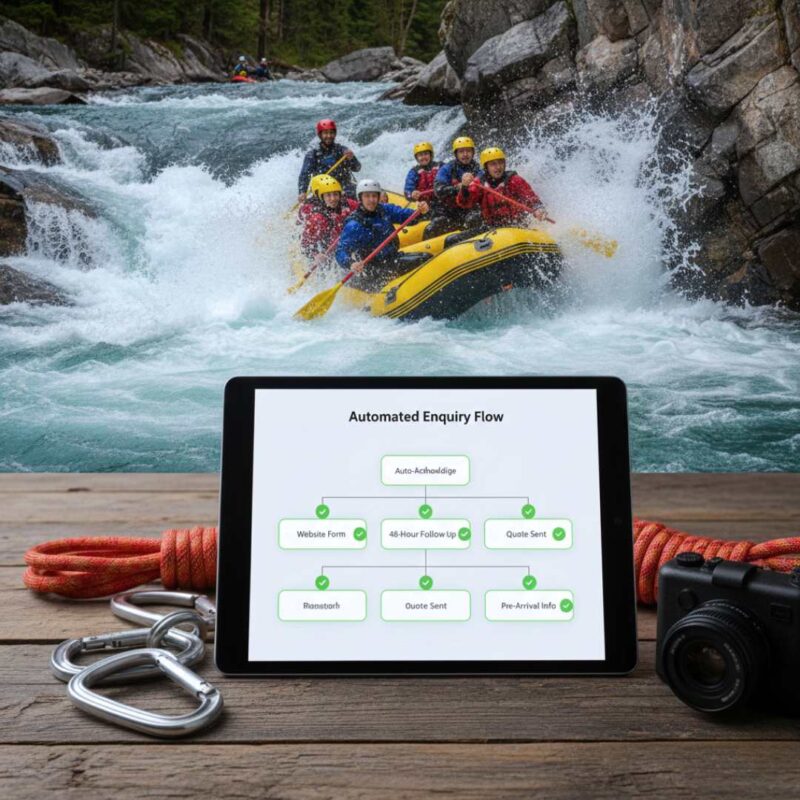
Why Good Enquiries Go Cold
Here’s a scenario that plays out constantly in small tourism businesses. Someone fills out your website enquiry form on a Tuesday morning. You’re with guests on a game drive, so you don’t see it until lunch. You send a reply with your rates and availability. Then you wait.
Wednesday passes. No response. Thursday comes, still nothing. By Friday, you’re wondering: should I follow up? Will I seem pushy? Maybe they’ve changed their mind.
Meanwhile, the potential guest is thinking: I sent that enquiry days ago and only got one reply. Are they even interested in my booking? Maybe I should try that other lodge that’s been more responsive.
By the time you do follow up, they’ve often booked elsewhere.
In my experience, this is how small tourism operators lose 30-40% of their potential bookings. Not because they provide poor service, not because their property isn’t good enough, but simply because enquiries slip through the cracks when things get busy.
The solution isn’t working harder or checking your email more often. It’s having a system that manages the entire enquiry-to-booking journey automatically, so nothing gets forgotten.
Want to see booking pipeline templates from other operators?
Join the Tourism AI Mastermind.
The Real Problem: Managing Enquiries Manually Doesn’t Scale
When you’re running a small tourism operation, you’re juggling dozens of responsibilities. Guiding tours, managing staff, handling maintenance, sourcing supplies, responding to reviews, dealing with suppliers. Staying on top of every enquiry, at every stage, whilst doing all of this is nearly impossible.
What usually happens is this:
Some enquiries get immediate attention because they arrive at the right time. Others sit in your inbox for hours or days because you’re busy. Some get one follow-up, others get forgotten entirely. There’s no consistency, and there’s no way to see at a glance which enquiries are hot, which are warm, and which have gone cold.
You might think: “I just need to be more organised.” But the issue isn’t organisation, it’s capacity. You simply can’t manually track and follow up with every enquiry whilst also running your business.
This is exactly what an enquiry pipeline solves. It creates a defined process that every single enquiry follows, automatically, so you never lose track of where things stand.
What an Enquiry Pipeline Actually Is
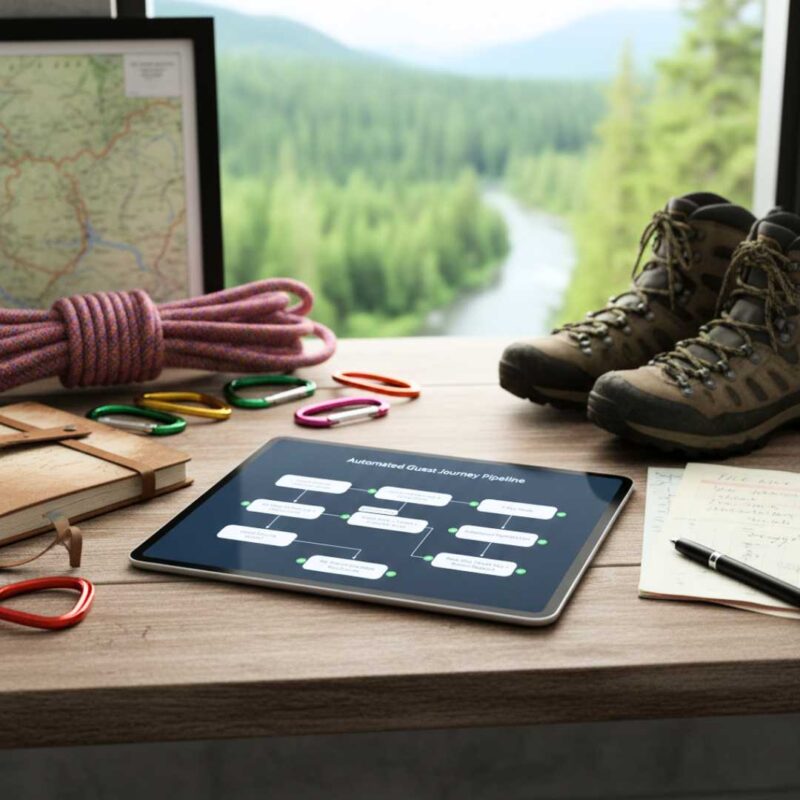
An enquiry pipeline is a step-by-step journey that guides potential guests from initial contact through to confirmed booking. Think of it like a series of stages, and each enquiry moves through those stages based on their actions (or inactions).
Here’s what a simple tourism enquiry pipeline might look like
Stage 1: New Enquiry Someone fills out your contact form or sends a message. The system immediately sends an acknowledgement: “Thanks for your enquiry! I’ll get back to you within 24 hours with availability and pricing.”
Stage 2: Quote Sent You (or the system) send them a personalised quote with rates, availability, and next steps. The enquiry moves to the “Quote Sent” stage.
Stage 3: Follow-Up Needed If they don’t respond within 48 hours, the system automatically sends a friendly follow-up: “Just checking in, did you have any questions about the quote I sent? Happy to help with any details.”
Stage 4: Negotiation/Questions If they reply with questions or requests for modifications, they move to this stage where you handle things personally.
Stage 5: Booking Confirmed Once they commit and pay the deposit, they move to “Booking Confirmed” and a new set of automated messages kicks in (confirmation email, pre-arrival information, etc.).
Stage 6: Closed/Lost If they go silent after multiple follow-ups, they move to “Closed” but stay on a nurture list for future promotions.
The beauty of this system is that it’s visible. You can see exactly how many enquiries are at each stage, which ones need your attention, and which ones are moving forward on their own.
Why Timing Matters More Than You Think
There’s a well-known principle in sales: the faster you respond to an enquiry, the more likely you are to convert it. In tourism, this is especially true because people are often comparing multiple options simultaneously.
If someone is researching safari lodges in Tanzania, they’re probably looking at four or five properties. They send enquiries to all of them. Whoever responds first, and whoever follows up consistently, usually wins the booking.
But here’s what I find: most operators know they should follow up, but they’re inconsistent about it. Sometimes they remember, sometimes they don’t. Sometimes they follow up once, sometimes three times. There’s no pattern, and potential guests can sense that.
An automated pipeline removes this inconsistency. Every enquiry gets the same level of attention, at the same intervals, regardless of how busy you are. The system doesn’t forget, doesn’t get distracted, and doesn’t worry about seeming pushy.
Building Your First Enquiry Pipeline in the GlobalThinkingApp

The GlobalThinkingApp makes building enquiry pipelines straightforward because everything is connected. Your enquiry forms, your email templates, your SMS messages, and your contact database all live in one place.
Here’s how to set it up:
Step 1: Map Out Your Current Enquiry Process
Before you build anything, write down what currently happens when an enquiry comes in. Be honest about the reality, not the ideal.
For example:
- Enquiry arrives via website form or email
- I reply when I have time (could be 2 hours, could be 12 hours)
- I send rates and availability
- I wait for their response
- Sometimes I follow up, sometimes I don’t
- If they book, I send confirmation manually
- If they don’t respond, they fall off my radar
Now think about what should happen. What’s the ideal journey?
Step 2: Create Your Pipeline Stages
In the GlobalThinkingApp, you set up a pipeline with clear stages. For most tourism businesses, you’ll want something like:
- New Enquiry
- Quote Sent
- Follow-Up Sent
- In Discussion
- Booking Confirmed
- Deposit Paid
- Closed/Lost
You can customise these based on your business. A tour operator might have a “Waitlist” stage. A luxury lodge might have a “VIP Enquiry” stage for high-value bookings.
Step 3: Build Your Automated Messages
This is where the real power comes in. For each stage, you create email or SMS templates that go out automatically when certain conditions are met.
For example:
Trigger: New enquiry received Action: Send immediate acknowledgement email
Template: “Hi [Name],
Thanks so much for your enquiry about [Property/Tour Name]. I’m excited to help you plan your visit.
I’ll send you full availability and pricing within the next 24 hours. In the meantime, feel free to browse our recent guest photos on Instagram [@yourhandle].
Looking forward to hosting you, [Your Name]”
Trigger: 48 hours after quote sent, no response Action: Send follow-up email
Template: “Hi [Name],
Just wanted to check in, did you have a chance to review the quote I sent over? I know planning a trip involves comparing a few options, so please let me know if you have any questions or need any additional information.
We still have availability for your dates, and I’d love to help make this happen.
Cheers, [Your Name]”
Trigger: 5 days after last contact, still no response Action: Send final follow-up
Template: “Hi [Name],
I haven’t heard back from you, so I’m guessing you might have decided to go in a different direction, which is completely fine.
If your plans change or you’d like to discuss options for a future trip, just let me know. I’ll keep your details on file and send you occasional updates about special offers.
All the best, [Your Name]”
Step 4: Set Up Manual Touchpoints
Not everything should be automated. Some stages require your personal input.
For instance, when an enquiry moves to “In Discussion” (because they’ve replied with questions), you should handle that personally. The system notifies you, and you respond with your expertise and judgement.
The key is that the system handles the routine steps (acknowledgements, follow-ups, reminders) so you can focus on the conversations that actually need you.
Step 5: Track and Refine
Once your pipeline is running, you can see metrics like:
- How many enquiries are coming in each week
- What percentage move from “Quote Sent” to “In Discussion”
- How many convert to bookings
- Which stage most enquiries drop off at
This data helps you improve. If lots of enquiries go cold after the first quote, maybe your pricing isn’t clear enough. If follow-ups aren’t getting responses, maybe the tone needs adjusting.
Real Examples: What This Looks Like in Practice
Let me give you a couple of scenarios to show how this works in real tourism businesses:
Example 1: Safari Lodge in Botswana
An enquiry comes in from a family in the UK asking about availability for July. The system immediately sends an acknowledgement. The lodge owner is on a game drive and sees the notification later. She reviews the enquiry, checks availability, and sends a personalised quote within 3 hours.
The family doesn’t respond for two days (they’re comparing options). The system automatically sends a friendly follow-up: “Just checking in, any questions about the quote?”
The family replies asking about child-friendly activities. This moves them to “In Discussion” and the owner responds personally with details about junior ranger programs and family suites.
They book. The system sends booking confirmation, payment link, and schedules pre-arrival emails for 30 days, 14 days, and 3 days before arrival.
Total manual work: Sending the initial quote and answering the question about kids. Everything else happened automatically.
Example 2: Adventure Tour Company in New Zealand
An enquiry comes in for a multi-day hiking tour. The system sends acknowledgement. The tour operator sends a quote and itinerary. No response for 48 hours, so the system sends a follow-up.
Still no response after another 3 days. The system sends a final follow-up: “It seems like the timing might not be right. I’ll keep you on our mailing list for future trips.”
The enquiry moves to “Closed” but stays on a nurture list. Three months later, during the off-season, the operator sends a promotional email about discounted winter tours. The original enquirer responds and books.
Total result: An enquiry that seemed lost actually converted, because the system kept them engaged without any manual effort.
Common Questions About Enquiry Pipelines
“Won’t automated follow-ups feel impersonal?”
Not if they’re written well. The key is to write follow-up messages that sound like you, not like a robot. Use your natural tone, keep them brief, and focus on being helpful rather than pushy.
Most guests won’t even realise it’s automated, they’ll just think you’re efficient and attentive.
“How many follow-ups is too many?”
In my experience, two or three follow-ups is about right. After that, if someone hasn’t responded, they’re either not interested or not ready. Move them to a nurture list and send occasional updates, but don’t chase them endlessly.
“What if I want to personalise some messages?”
You absolutely can. The pipeline handles the routine steps, but you can always jump in and send a personal message whenever you want. The system is there to support you, not replace you.
“Will this work if I only get a few enquiries a week?”
Yes, actually it’s even more valuable. If you’re only getting 5-10 enquiries a week, you can’t afford to lose any of them. A pipeline ensures every single one gets proper attention.
What Success Looks Like
After a few weeks of running an enquiry pipeline, here’s what you should expect:
Faster response times: Every enquiry gets acknowledged immediately, even if you’re busy.
Higher conversion rates: Consistent, timely follow-ups mean more enquiries turn into bookings. Most operators see a 20-30% improvement.
Less mental load: You’re not trying to remember who you need to follow up with or when. The system handles it.
Better visibility: You can see exactly where each enquiry stands, which ones are hot, and which need attention.
More time for guests: Because routine communication is automated, you spend your time on meaningful conversations, not admin.
Getting Started: Your First Pipeline
If you’re ready to build an enquiry pipeline, here’s what I recommend:
- Write down your ideal enquiry journey (from first contact to booking confirmation)
- Identify 3-4 key stages where enquiries typically are
- Draft 2-3 email templates (acknowledgement, follow-up, final follow-up)
- Set up a basic pipeline in the GlobalThinkingApp
- Connect your enquiry form so new leads flow in automatically
- Test it by submitting an enquiry yourself
- Launch and monitor for a week, then refine based on what you see
Start simple. You can always add complexity later.
Continue the Conversation
Building an enquiry pipeline is one of those things that seems complicated until you actually do it. Then you wonder why you waited so long.
In the Tourism AI Mastermind, operators share their pipeline structures, email templates, and conversion tips. It’s a great place to see real examples and get feedback on your own setup.
Join the Tourism AI Mastermind here to access templates and learn from other operators.
What’s Next
Now that you’ve got a system for capturing and converting enquiries, the next challenge is keeping your brand visible and engaging through content.
That’s where AI-assisted storytelling comes in.
Read the next article: Content Without Burnout, AI-Assisted Storytelling for Tourism —–>
Or return to the main guide: Tourism AI: A Practical Guide for Small Operators —-->
About This Series
This is part of a six-part series on Tourism AI for small operators. Each article focuses on one specific challenge and shows you how to solve it practically, without needing technical expertise.
- Guest Enquiries & AI Chat Support
- Booking Follow-Ups & Enquiry Pipelines (you are here)
- Content & Storytelling for Tourism Brands
- Social Media Systems for Tourism Operators
- Seasonal Workflow Automation
- Guest Lifecycle & Relationship Management
Block "6849" not found
