
The Most Valuable Guest Isn’t the One Who Books Once
Here’s a truth that many tourism operators miss: the real profit in your business doesn’t come from constantly finding new guests. It comes from turning good guests into repeat guests, and repeat guests into advocates who refer their friends and leave glowing reviews.
But in my experience, most small tourism businesses treat the guest relationship like a single transaction. Someone enquires, you respond, they book, they visit, they leave. Then you wave goodbye and move on to the next enquiry.
Maybe you send a quick thank you email. Maybe you ask for a review. But then the relationship ends. That guest, who had an amazing experience and would happily book again or recommend you to others, simply falls off your radar.
A year later, they’re planning another trip. But because you haven’t stayed in touch, they don’t think of you. They search Google, find a competitor, and book elsewhere.
This is the silent revenue leak that costs tourism operators thousands every year. Not because they’re providing poor service, they’re not, but because they’re not managing the full guest lifecycle.
Guest lifecycle management means treating every guest relationship as an ongoing journey, not a one-time event. It means staying connected, providing value, and making it easy for past guests to book again or refer others.
Want to see guest lifecycle systems from other operators?
Join the Tourism AI Mastermind.
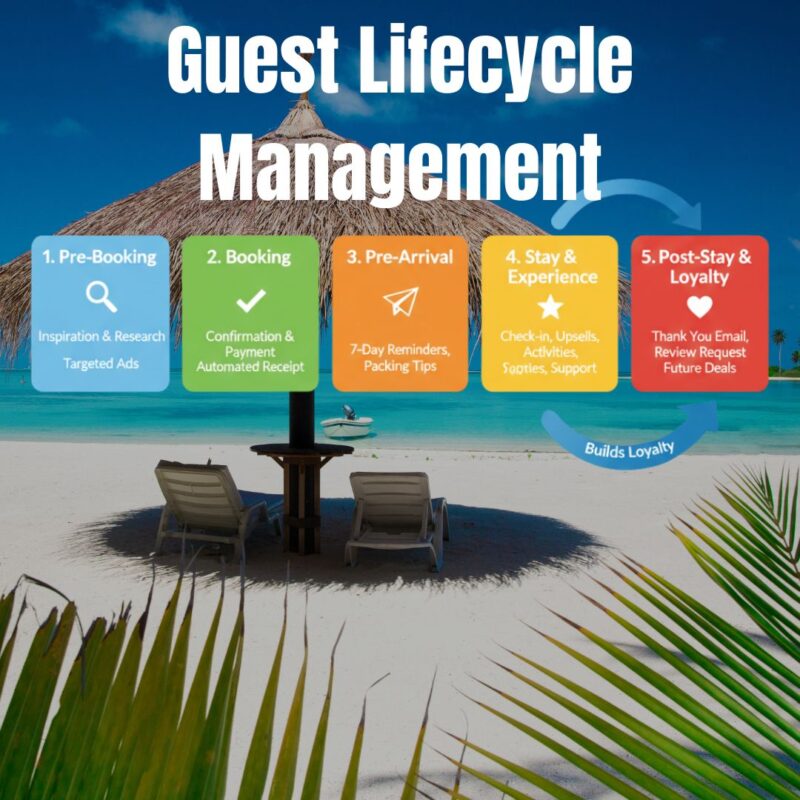
The Four Stages of the Guest Lifecycle
Every guest moves through four distinct stages in their relationship with your business. Each stage requires different communication and different goals.
Stage 1: Pre-Booking (Enquiry to Booking)
This is where someone first discovers you, sends an enquiry, and decides whether to book.
What they need: Fast responses, clear information, reassurance that you’re professional and trustworthy.
Your goal: Convert the enquiry into a confirmed booking.
Key touchpoints:
- Initial enquiry acknowledgement
- Quote or availability information
- Follow-up if they don’t respond
- Booking confirmation once they commit
We covered this in detail in the article on booking pipelines. The point is: this stage is about building trust quickly and making booking easy.
Stage 2: Pre-Arrival (Booking to Arrival)
This is the period between when someone books and when they actually arrive. It could be weeks or months.
What they need: Reassurance that everything is organised, practical information about what to expect, excitement about their upcoming trip.
Your goal: Keep them engaged, prevent cancellations, and ensure they arrive prepared.
Key touchpoints:
- Booking confirmation and payment details
- Pre-arrival information (what to pack, how to get there)
- Dietary and special request confirmations
- Countdown messages (“Looking forward to welcoming you in 7 days!”)
This stage is where many operators drop the ball. They confirm the booking, then go silent until arrival. But maintaining contact during this period reduces cancellations and builds anticipation.
Stage 3: During Stay (Arrival to Departure)
This is when the guest is actually with you. It’s the most important stage because this is where the experience happens.
What they need: Personal attention, smooth operations, memorable moments.
Your goal: Deliver an outstanding experience that they’ll remember and want to repeat.
Key touchpoints:
- Welcome and orientation
- Daily interactions (meals, activities, conversations)
- Handling any issues or special requests
- Farewell and departure
This stage should be mostly personal, not automated. This is where you shine as a host. But having systems in place (like automated welcome messages or activity schedules) frees you up to focus on genuine connection rather than admin.
Stage 4: Post-Stay (After Departure)
This is the most neglected stage, and the most valuable. After someone leaves, most operators forget about them. But this is when you turn a one-time guest into a repeat guest or referral source.
What they need: Acknowledgement of their visit, easy ways to stay connected, reasons to return.
Your goal: Get reviews, encourage repeat bookings, generate referrals.
Key touchpoints:
- Thank you message
- Review request
- Birthday or anniversary messages
- Special offers for return visits
- Seasonal newsletters keeping you top-of-mind
This is where guest lifecycle management really pays off. A simple, consistent post-stay system can double your repeat booking rate.
Why Most Operators Struggle With Lifecycle Management
The challenge isn’t that operators don’t understand the value of staying in touch. It’s that they don’t have a system for it.
Here’s what usually happens:
You intend to send a thank you email after checkout. But you’re busy with new arrivals, so you forget. A week later, you remember and send it, but it feels a bit late. You think “I should ask for a review,” but you’re not sure how to phrase it without sounding pushy, so you don’t.
Three months later, you think “I should reach out to past guests with a special offer.” You draft an email, send it to a few people you remember, but you don’t have a proper mailing list so you miss most of them.
Six months later, it’s someone’s birthday. You have no idea, so you don’t send anything.
The information is scattered. Email addresses are in your inbox, booking details are in a spreadsheet, preferences and notes are in your head or scribbled in a notebook. There’s no central place to see who’s stayed, when, what they liked, and when to follow up.
This is exactly what a CRM (Customer Relationship Management system) solves. It keeps all guest information in one place and automates the lifecycle communication so nothing gets forgotten.
Building a Guest Lifecycle System in the GlobalThinkingApp

The GlobalThinkingApp acts as your central hub for managing guest relationships. Every enquiry, booking, and interaction is tracked in one system.
Here’s how to set it up:
Step 1: Capture Every Contact
Every person who enquires, books, or interacts with your business should be in your CRM. This includes:
- Website enquiry form submissions
- Email enquiries
- Social media messages
- Phone enquiries (entered manually)
- Walk-in enquiries
- Past guests from before you started using the system (import them)
Each contact record includes:
- Name, email, phone number
- Enquiry date and source (website, Instagram, referral, etc.)
- Booking history (dates stayed, room type, activities)
- Preferences and notes (dietary requirements, interests, special occasions)
- Tags (e.g., “Past Guest”, “VIP”, “Wildlife Enthusiast”, “Repeat Booker”)
Step 2: Tag and Segment Your Guests
Tags let you group guests by characteristics or behaviour. This makes it easy to send targeted communications.
Common tags for tourism businesses:
- Booking status: Enquiry, Booked, Past Guest, Repeat Guest
- Interests: Wildlife Photography, Birdwatching, Adventure, Relaxation
- Guest type: Solo Traveller, Couple, Family, Group
- Value: VIP, High Spender, Budget Conscious
- Engagement: Reviewed Us, Referred Others, Newsletter Subscriber
For example, you might send a special offer on photography workshops only to guests tagged “Wildlife Photography”. Or you might send a family-friendly activity update only to guests tagged “Family”.
Step 3: Automate Lifecycle Communication
Once your contacts are in the system, you create automated workflows for each stage of the lifecycle.
Pre-Booking Workflows:
- Enquiry acknowledgement (immediate)
- Quote sent (within 24 hours)
- Follow-up if no response (48 hours later)
- Final follow-up (5 days later)
Pre-Arrival Workflows:
- Booking confirmation (immediate)
- Pre-arrival information (14 days before arrival)
- Payment reminder (7 days before final payment due)
- Welcome message (arrival day)
Post-Stay Workflows:
- Thank you email (day after checkout)
- Review request (day after checkout)
- Review reminder (7 days later if no review)
- Add to “Past Guests” segment for future marketing
Ongoing Engagement Workflows:
- Birthday message with special offer (on birthday)
- Anniversary message (12 months after first stay)
- Seasonal newsletter (monthly or quarterly)
- Special offers for return visits (during off-season)
These workflows run automatically. You set them up once, and they work in the background for every guest.
Step 4: Track Interactions and History
Every email sent, every booking made, every note added, all of it lives in the contact record. When a past guest enquires again, you can see:
- When they last stayed
- What room they had
- What activities they enjoyed
- Any preferences or special requests
- Previous communication history
This lets you personalise your response: “Great to hear from you again! I remember you loved the early morning game drives last time. We’ve got some incredible sightings this season.”
This level of personalisation is impossible when information is scattered across multiple systems or lost in old emails.
Real Examples: Lifecycle Management in Action
Let me show you what this looks like in practice:
Example 1: Turning a One-Time Guest Into a Repeat Visitor
June 2024: Sarah and Tom stay at your lodge for their honeymoon. They have an amazing time.
Day after checkout: Automated thank you email sent: “We loved hosting you! We’d be grateful if you’d share your experience on TripAdvisor: [link]”
3 days later: They leave a 5-star review. You respond personally, thanking them.
December 2024 (6 months later): Automated email sent: “Hi Sarah and Tom, it’s been six months since your honeymoon stay with us. We’d love to welcome you back. Here’s an exclusive return guest offer: 20% off any booking in our green season (January-March). Just for you.”
March 2025: They book again, this time for a long weekend.
Total manual effort: Responding to their review. Everything else was automated.
Example 2: Generating Referrals From Happy Guests
August 2024: James stays for a week-long hiking tour. He has a great experience.
Day after checkout: Automated thank you and review request sent. He leaves a review.
September 2024: You send a personalised email: “James, thanks again for the glowing review. If you know anyone else who’d enjoy our hiking tours, we’d love to offer them (and you) a 15% referral discount. Just share this link: [referral link]”
October 2024: James refers his friend Mike. Both get 15% off their bookings.
November 2024: Mike books and mentions James referred him. The system tracks this and credits James’s account.
Result: One happy guest turned into two bookings with minimal effort.
Example 3: Re-Engaging Cold Enquiries
January 2024: Lisa enquires about your wildlife photography tour but doesn’t book. She goes into your CRM tagged as “Cold Enquiry – Photography Interest”.
July 2024 (6 months later, during off-season): Automated email sent: “Hi Lisa, you enquired about our photography tours earlier this year. We’d still love to host you. Our green season (September-November) offers incredible light, fewer crowds, and 25% off our standard rates. Availability is limited. Interested?”
August 2024: Lisa responds and books for October.
Result: An enquiry that seemed lost converted six months later because the system kept her engaged.
Using Lifecycle Data to Improve Your Business

Guest lifecycle management isn’t just about automation. It’s also about learning from your guest data.
The GlobalThinkingApp lets you track:
- Repeat booking rate: What percentage of guests return?
- Review rate: What percentage leave reviews?
- Referral rate: How many guests refer others?
- Booking to stay time: How long between booking and arrival?
- Popular activities or room types: What do guests request most?
- Seasonal patterns: When do different guest types prefer to visit?
This data helps you make better decisions:
- If repeat bookings are low, improve your post-stay engagement
- If reviews are low, adjust your review request timing or messaging
- If certain activities are popular, promote them more heavily
- If bookings are declining in a specific season, create targeted offers
You’re not guessing what works. You’re using actual guest behaviour to inform your strategy.
Personalisation at Scale
Here’s what makes lifecycle management powerful: you’re providing personalised communication to dozens or hundreds of guests without manually writing each message.
The system knows:
- When someone stayed
- What they were interested in
- Whether they’ve returned before
- When their birthday is
- Whether they left a review
It uses this information to send relevant, timely messages that feel personal even though they’re automated.
For example:
- A couple who stayed for their anniversary gets an anniversary message 12 months later
- A wildlife enthusiast gets updates about recent rare sightings
- A family gets information about new family-friendly activities
- A repeat guest gets early access to special offers
Each guest receives communication that’s relevant to them, which dramatically improves engagement and conversion.
Balancing Automation With Personal Touch
One concern I hear from operators is: “Won’t this feel impersonal?”
The answer is no, if you do it right.
Automation handles the routine touchpoints (confirmations, reminders, thank you messages) so you have more time for genuine personal interaction. The system ensures nothing gets forgotten, but you’re still free to add personal touches whenever you want.
For example:
- The system sends a birthday message automatically, but you can add a handwritten note
- The system requests a review, but you personally respond to every review received
- The system sends seasonal newsletters, but you add personal stories and updates
Automation doesn’t replace personal service. It supports it by handling the repetitive tasks so you can focus on meaningful connection.
Common Questions About Guest Lifecycle Management
“How often should I contact past guests?”
It depends on your business, but a good baseline is:
- Thank you and review request immediately after stay
- Quarterly or seasonal newsletter with updates and offers
- Birthday or anniversary message (if you have that information)
- Special targeted offers during off-season
Avoid overwhelming people with weekly emails. Quality and relevance matter more than frequency.
“What if guests unsubscribe from my emails?”
That’s fine. Not everyone wants ongoing communication. The system tracks unsubscribes automatically and stops sending them emails. Focus on the people who do want to stay connected.
“Should I treat all guests the same or segment them?”
Segmentation is more effective. A solo adventure traveller and a family looking for relaxation have different interests. Tailor your communication to what’s relevant to each group.
“What if I don’t have much data on past guests?”
Start collecting it now. Every new guest interaction adds to your database. Over time, you’ll build a valuable contact list. You can also manually add past guests from old booking records if you have them.
Tourism AI Community Learning
Our weekly AI Business Mastermind is a FREE dedicated space for tourism professionals to collaborate on real-world AI challenges and build collective intelligence. Join us this week to share insights and take away practical solutions you can use immediately.

Getting Started With Guest Lifecycle Management
If you’re ready to build a lifecycle system, here’s what I recommend:
- Import or enter your existing guest contacts into the GlobalThinkingApp CRM
- Create basic tags (Past Guest, Enquiry, VIP, etc.)
- Set up one post-stay workflow (thank you and review request)
- Test it with upcoming checkouts to make sure it works
- Add a birthday or anniversary workflow once you’re comfortable
- Build a quarterly newsletter to keep past guests engaged
- Track results (review rates, repeat bookings, referrals)
- Expand and refine over time
Start simple. Even just automating thank you messages and review requests will make a difference.
The Long-Term Value of Guest Relationships
Here’s the reality: acquiring a new guest costs significantly more than getting a past guest to return. Marketing to strangers requires advertising, content, SEO, and time. Marketing to past guests requires a simple email saying “We’d love to see you again.”
A tourism business with strong lifecycle management:
- Gets more repeat bookings (higher lifetime value per guest)
- Gets more referrals (lower acquisition costs)
- Gets more reviews (better online reputation, more organic bookings)
- Builds a community of loyal guests (more stable, predictable revenue)
This compounds over time. After a few years of consistent lifecycle management, a significant portion of your bookings come from past guests and referrals rather than cold enquiries. This is more profitable and far less stressful than constantly chasing new leads.
Continue the Conversation
Guest lifecycle management is one of those systems that gets better the longer you use it. The more data you collect, the more personalised and effective your communication becomes.
In the Tourism AI Mastermind, operators share lifecycle workflows, discuss what messaging works best, and troubleshoot common challenges like improving review rates or re-engaging cold enquiries.
Join the Tourism AI Mastermind here to see real lifecycle systems and get help building your own.
Bringing It All Together
This is the final article in the six-part series on Tourism AI for small operators. We’ve covered:
- Guest Enquiries & AI Chat Support – Responding 24/7 without burning out
- Booking Follow-Ups & Enquiry Pipelines – Making sure no enquiry falls through the cracks
- Content & Storytelling – Creating authentic content without hiring a writer
- Social Media Systems – Maintaining consistent visibility through batching and automation
- Seasonal Workflow Automation – Managing peak chaos and off-season quiet
- Guest Lifecycle Management – Turning one-time guests into repeat visitors and advocates ( You Are Here)
Return to the main guide – Tourism AI: A Practical Guide for Tour Operators —–>
Each piece works on its own, but they’re even more powerful together. The enquiry chatbot feeds into your booking pipeline. The booking pipeline triggers lifecycle workflows. Social media engagement drives enquiries. Content keeps past guests engaged. Everything connects through one system, the GlobalThinkingApp.
You’re not using five different tools. You’re using one connected platform where each piece supports the others.
Where to Start
If you’ve read all six articles and you’re wondering where to begin, here’s my recommendation:
Start with the problem causing you the most pain right now.
- Losing enquiries? Start with chat support and enquiry pipelines.
- Overwhelmed during peak season? Start with operational workflows.
- Struggling to stay visible? Start with content batching and social media.
- Not getting repeat bookings? Start with lifecycle management.
Pick one. Build it. Get it working. Then move to the next.
And if you’d like to discuss any of this with other operators who are on the same journey, come join us in the Tourism AI Mastermind. We’d be glad to have you.
Join the Tourism AI Mastermind here – it’s free.
Block "6849" not found
